
Earth Month 2026: Leading Cambridge Climate Scientist Shaun Fitzgerald on the State of the Planet
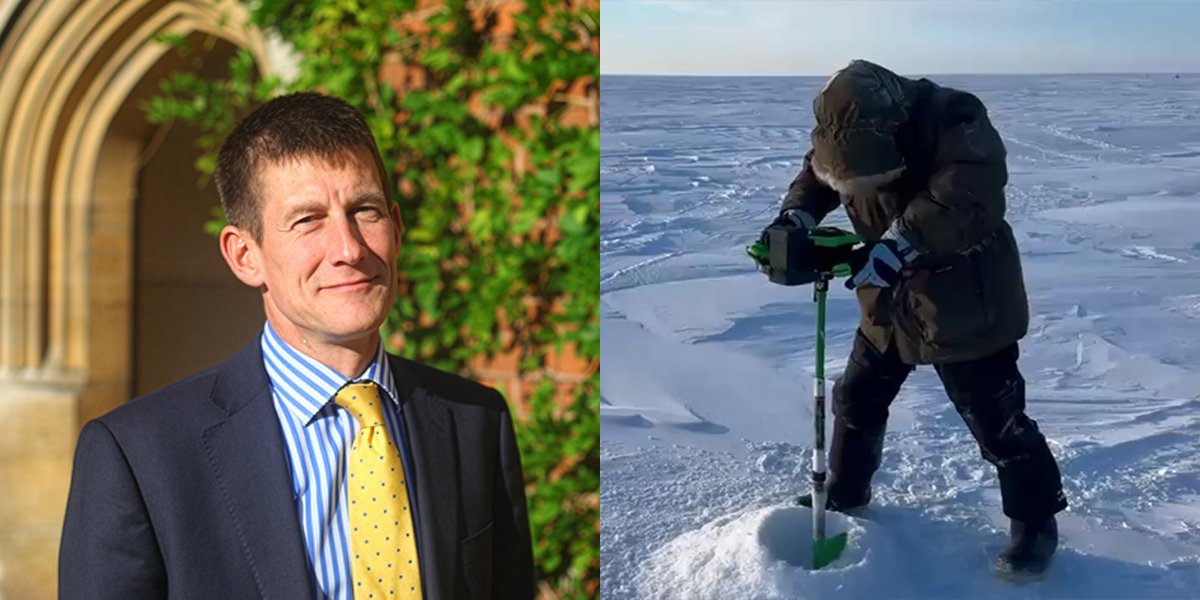
Shaun Fitzgerald (Girton 1986), Research Professor in the Centre for Climate Repair at Cambridge leads some of the University’s and the UK’s most innovative climate change intervention projects. He has spent decades working on technology to accelerate the energy transition — from geothermal power to greener buildings. Now he's focused on urgent solutions designed to buy the planet time. Fitzgerald described Cambridge’s cutting-edge research into geoengineering techniques and shared why climate change and its myriad consequences may be humanity's greatest challenge yet.
Where are we globally in terms of climate risk?
That's a big question — but even asking about 'risks' is interesting, because some of what we're facing is fairly certain, not just possible. How certain are we that we'll go above 1.5 or 2 degrees centigrade? Fairly certain. The Intergovernmental Panel on Climate Change (IPCC) has done a good job distilling the consequences: increased droughts, flooding events, loss of crops, rising sea levels, and food insecurity.
Over the next forty to fifty years, we're going to see massive changes — particularly in low-lying coastal areas. And unfortunately, the people who will be most affected are those who are least able to adapt. Climate refugees, climate migrants — these are political realities we're going to have to grapple with. Ecosystems will be seriously affected. It won't necessarily unfold dramatically — it will be an ever-increasing accumulation of events, with overall increasing frequency and severity of severe weather events or flooding from sea level rise.
Of the scenarios the IPCC presents that we'd most like to achieve — the most aggressive on emissions reduction and greenhouse gas removal — are the least likely. The ones we're most likely to achieve involve higher temperatures and all the consequences that come with them. That's the uncomfortable reality.
What are the most promising solutions under consideration now; what is meant by refreezing the Arctic?
We need a suite of solutions to tackle climate change. The strategy starts with reducing emissions. We have to stop the problem from getting worse. We then have to remove some of the excess greenhouse gases from the atmosphere. But we also need to look at something we call ‘refreeze’. This is partly because when we look at things to try and keep a lid on temperature rise, we are fully aware that the Arctic is warming 3-4 times faster than the global average and the consequences of accelerating temperature rise there are horrible. This gives a clear strategy of reduce, remove and refreeze. What we mean by 'refreeze the Arctic' is climate engineering, or geoengineering — interventions designed to cool the planet more rapidly while we fix the underlying problem of greenhouse gas levels.
Most of the ideas we're exploring are drawn from our observations of what nature has taught us. The best-known approach is stratospheric aerosol injection based on lessons learned from large volcanic eruptions. When Mount Pinatubo erupted in 1991, it delivered around seventeen million tons of sulphur dioxide into the stratosphere over just a few days. That gas reacted with water vapor to form tiny droplets of sulphuric acid — the right size to reflect a portion of solar radiation back out to space. The result was the Earth cooling by roughly half a degree Celsius for one to three years. We know this happens. The question is: can we replicate it deliberately, more safely, and sustain it?
The second major approach is marine cloud brightening. Over land, clouds form readily because there are particles — dust, aerosols — that act as cloud condensation nuclei. Over the open ocean, especially on the downwind side of large ocean stretches, those nuclei are scarce. What if we provided more sea salt aerosols, created more sea spray in specific ocean areas, and triggered the formation of more, smaller water droplets in clouds? That would increase cloud reflectivity and potentially cool regional temperatures. Again — we're drawing directly from what nature already does.
Some have called this research a 'last resort.' Is that how you see it?
I wish we didn't need this work at all. I've spent most of my career trying to prevent carbon dioxide from going into the atmosphere in the first place. But given where we are, I think it's essential that we examine these tools and determine whether they can keep a lid on temperatures while we continue fixing the underlying problem.
The analogy I use is medicine. If a patient has a serious underlying illness but is bleeding to death, you stop the bleeding while you treat the illness. Band-aids aren't a long-term solution — but a band-aid might be what keeps people alive, keeps entire countries from being lost to sea level rise. I'm not saying this is a good thing. I'm saying we need to compare the risks of these interventions against the risks of unchecked climate change.
How urgent is this work, and what does the next decade look like?
Very urgent. Our plan is to spend the next five years developing technologies and modelling, identifying which approaches look scalable and could realistically affect temperatures. The following five years would involve broader societal engagement — working with communities, governments, environment agencies to understand what is acceptable, how governance would work, who gets a say. By the end of that decade, we should be in a position to say: here is a capability we could begin to deploy, responsibly and carefully.
I see the researcher's role shifting. In the first five years, we're driving the intellectual work in modelling and the lab, and working with local communities in any field experiments. In the second five, we're definitely mainly supporting others — community groups, nations, regulatory bodies — who take the lead. This is not something researchers can or should roll out unilaterally. It has to be led by society.
What is Cambridge's role in all of this?
The Centre for Climate Repair is involved in four of the five outdoor experiments currently funded by ARIA — the UK's Advanced Research and Invention Agency. We're leading two and supporting two others. No other university, to my knowledge, is involved in as many different types of climate intervention and greenhouse gas removal projects.
But I want to be careful about how I frame that. Cambridge's role isn't to lead the field — it's to be part of a global community of universities and organizations working collaboratively. Leadership in research, like trust, is something that's earned. Others ask you to lead certain projects, and that is what has happened here. We're proud of it, but we hold it lightly. There is far too much to be done for any single institution to claim ownership of this space.
* Learn more about Professor Shaun Fitzgerald and his work with the Centre for Climate Repair here. To sustain this vital research, please consider making a donation to Cambridge in America in support of Cambridge's Centre for Climate Repair.